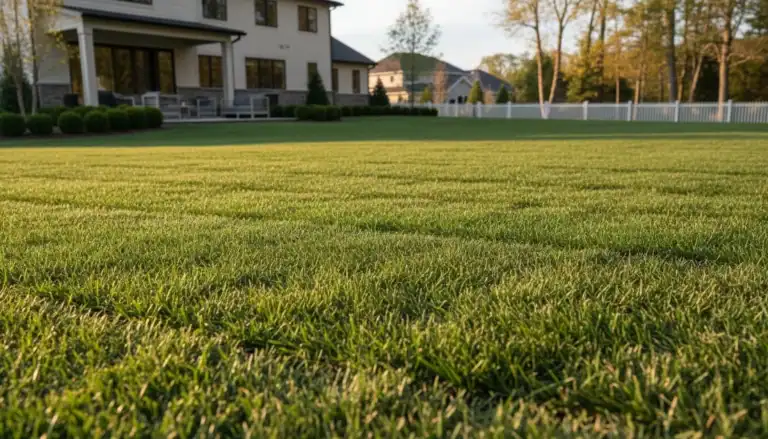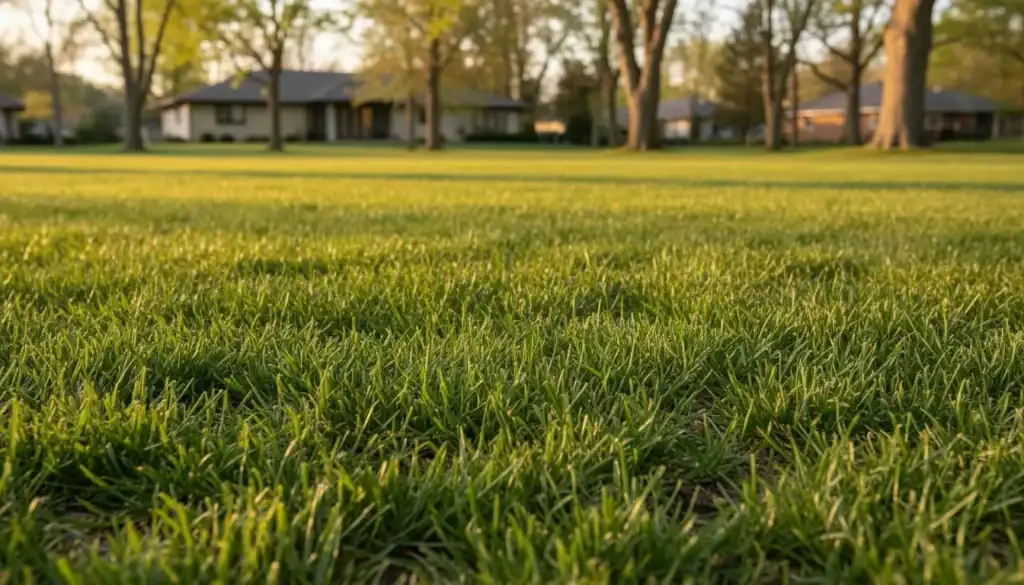
Kentucky bluegrass requires 1-1.5 inches of water weekly, fertilization 3-4 times per year with a 3-1-2 or 4-1-2 NPK ratio, and mowing heights between 2-3 inches during growing season. This premium cool-season grass thrives in temperatures of 60-75°F and needs full sun to light shade with well-draining soil at pH 6.0-7.0.
Kentucky bluegrass (Poa pratensis) dominates northern lawns from the Midwest to New England because it creates the densest, most luxurious turf when properly maintained. But let’s be honest, it’s also the most demanding grass you can grow. KBG wants more water, fertilizer, and attention than other cool-season grasses like tall fescue or fine fescue.
Key Takeaways
- Water deeply 1-2 times weekly providing 1-1.5 inches total, never daily shallow watering
- Fertilize with 2-4 pounds nitrogen per 1,000 sq ft annually, split into 3-4 applications
- Maintain mowing height at 2-3 inches in summer, 1.5-2 inches in spring/fall
- Plant or overseed in late summer (August 15-September 15) for best establishment
- Requires 6+ hours direct sunlight daily and soil pH between 6.0-7.0
- Goes dormant and browns during summer drought stress without irrigation
What Makes Kentucky Bluegrass Different from Other Grasses?
Kentucky bluegrass spreads through underground rhizomes, creating a self-repairing lawn that fills in bare spots naturally. Unlike bunch-type grasses such as tall fescue or perennial ryegrass, KBG forms a continuous mat that recovers from traffic damage.
The grass blade has a distinctive boat-shaped tip and prominent parallel veins. Mature KBG develops a deep blue-green color that gives the grass its name. According to the University of Minnesota Extension, Kentucky bluegrass requires 40-50% more water and fertilizer than tall fescue to maintain quality.
Here’s where KBG gets tricky: it enters dormancy during hot, dry periods above 85°F, turning brown until cooler temperatures and moisture return. This survival mechanism protects the crown and root system, but you need patience if you’re used to green lawns year-round.

How Much Water Does Kentucky Bluegrass Need?
Kentucky bluegrass needs 1-1.5 inches of water weekly during active growth periods. Water deeply 1-2 times per week rather than daily shallow watering to encourage deep root development.
Apply water early morning between 4-8 AM to minimize evaporation and disease pressure. Each watering session should wet the soil to 6-8 inches deep. Use a rain gauge or empty tuna can to measure application rates from sprinklers.
During summer heat stress above 85°F, KBG naturally reduces water uptake and may enter dormancy despite irrigation. The Penn State Extension recommends reducing watering frequency during dormancy to prevent root rot while maintaining just enough moisture to keep crowns alive.
| Season | Weekly Water Needs | Frequency | Application Depth |
|---|---|---|---|
| Spring (50-75°F) | 1-1.5 inches | 2-3 times | 6-8 inches soil depth |
| Summer (75-85°F) | 1.5-2 inches | 2 times | 8-10 inches soil depth |
| Summer dormancy (85°F+) | 0.5-1 inch | 1 time | 4-6 inches soil depth |
| Fall (50-75°F) | 1-1.5 inches | 2-3 times | 6-8 inches soil depth |
What’s the Best Fertilization Schedule for Kentucky Bluegrass?
Apply 2-4 pounds of nitrogen per 1,000 square feet annually, split into 3-4 applications throughout the growing season. Use a 3-1-2 or 4-1-2 NPK ratio fertilizer for optimal results.
The most critical feeding occurs in early fall (Labor Day to mid-October) when KBG stores energy for winter survival and spring green-up. This application should provide 1-1.5 pounds of nitrogen per 1,000 square feet.
Spring fertilization helps with early green-up, but don’t go crazy with heavy nitrogen applications before Memorial Day. Late spring/early summer feeding supports active growth during KBG’s peak growing season.
| Application Timing | N Rate (lbs/1000 sq ft) | Purpose | Fertilizer Type |
|---|---|---|---|
| Early Spring (April) | 0.5-1.0 | Green-up, root development | Slow-release granular |
| Late Spring (May) | 0.5-1.0 | Growth support | Quick-release or liquid |
| Early Fall (Sept) | 1.0-1.5 | Winter prep, spring energy | Slow-release granular |
| Late Fall (Nov) | 0.5 | Winter hardiness | Potassium-heavy blend |

How Should You Mow Kentucky Bluegrass?
Maintain Kentucky bluegrass at 2-3 inches during summer months and 1.5-2.5 inches during spring and fall. Never cut more than one-third of the blade length in a single mowing.
Taller grass shades the soil, reducing weed germination and helping retain moisture during heat stress. Lower mowing heights in spring and fall take advantage of cooler temperatures when KBG tolerates closer cutting.
Keep mower blades sharp and replace them annually. Dull blades tear grass tips, creating entry points for disease pathogens. In our testing, rotary mowers work fine for home lawns, but reel mowers create the cleanest cut on dense KBG.
Mow when grass is dry to prevent clumping and disease spread. During peak growth periods in spring and fall, you may need to mow twice weekly to maintain proper height without violating the one-third rule.
When Should You Plant or Overseed Kentucky Bluegrass?
Plant new Kentucky bluegrass seed between August 15 and September 15 for best establishment before winter. This timing allows 6-8 weeks of growth before first frost.
Spring seeding (April-May) works but requires more irrigation during summer and faces competition from annual weeds like crabgrass. Fall-seeded KBG establishes deeper roots and better heat tolerance the following summer.
Prepare the seedbed by loosening soil to 4-6 inches deep and incorporating 2-3 inches of compost. KBG seed needs good soil contact but should not be buried deeper than 1/4 inch. Apply seed at 2-3 pounds per 1,000 square feet for new lawns, 1-2 pounds for overseeding.
Keep soil consistently moist during the 14-21 day germination period. Light, frequent watering prevents seed from drying out without creating muddy conditions that wash seed away.

What Soil Conditions Does Kentucky Bluegrass Prefer?
Kentucky bluegrass thrives in well-draining soil with pH between 6.0-7.0. The grass tolerates slightly alkaline conditions better than acidic soil below 6.0.
Heavy clay soils need amendment with compost or sand to improve drainage. KBG develops shallow root systems in compacted soil, making it more susceptible to drought and wear damage. According to the University of Wisconsin Extension, KBG performs best in loamy soils with 2-4% organic matter.
Test your soil every 2-3 years to monitor pH and nutrient levels. Add lime in fall to raise pH gradually, or sulfur to lower pH if needed. Work amendments into the soil during renovation rather than surface application for lasting improvement.
| Soil Factor | Ideal Range | Poor Performance | Amendment Needed |
|---|---|---|---|
| pH | 6.0-7.0 | Below 5.5 or above 8.0 | Lime (raise) or sulfur (lower) |
| Drainage | 1-3 inches/hour | Standing water >24 hours | Compost, sand, drainage tiles |
| Organic matter | 3-5% | Below 2% | Compost, aged manure |
| Compaction | Below 300 psi | Above 400 psi | Core aeration, topdressing |
How Much Sunlight Does Kentucky Bluegrass Need?
Kentucky bluegrass requires 6-8 hours of direct sunlight daily for optimal density and color. The grass tolerates light shade but becomes thin and weak in areas receiving less than 4 hours of sun.
Shaded KBG areas develop longer, softer blades that lay flat rather than standing upright. These areas also stay wet longer after irrigation or rainfall, increasing disease pressure from fungi like dollar spot and brown patch.
Consider shade-tolerant alternatives like fine fescue for areas under trees or north-facing slopes that receive limited sunlight. Mixing KBG with 10-20% fine fescue helps maintain coverage in transitional light conditions.
Get a Free Personalised Lawn Plan
Answer 3 quick questions about your lawn and we'll build a custom care plan — tailored to your grass type, climate, and biggest challenges.
Build My Lawn Plan →
What Are Common Kentucky Bluegrass Diseases and Problems?
Dollar spot, brown patch, and summer patch rank as the most common Kentucky bluegrass diseases. These fungal problems thrive in warm, humid conditions with poor air circulation.
Dollar spot appears as silver-dollar sized tan circles throughout the lawn, often during periods of high humidity and nitrogen deficiency. Brown patch creates larger circular dead areas up to 3 feet across during hot, humid weather. Summer patch causes irregular dead zones that expand outward from infection centers.
Prevent disease through proper cultural practices: water early morning, maintain adequate nitrogen levels, and improve air circulation by pruning nearby shrubs. Fungicide applications may be necessary for severe outbreaks, but cultural controls provide long-term prevention.
Grub damage appears as irregular brown patches that peel up like carpet, typically noticed in late summer. Apply preventive grub control (imidacloprid or clothianidin) in late spring for season-long protection.
How Do You Aerate and Dethatch Kentucky Bluegrass?
Core aerate Kentucky bluegrass annually in fall when soil moisture is adequate but not saturated. Remove cores 2-3 inches deep spaced 4-6 inches apart across the entire lawn area.
KBG develops thatch layers exceeding 0.5 inches due to its dense growth habit and slower decomposition rate compared to other grasses. Power rake or dethatch when thatch exceeds 0.75 inches, typically every 2-3 years.
Combine aeration with overseeding and topdressing for maximum renovation benefit. Apply 1/4-1/2 inch of quality compost after aeration to improve soil structure and provide organic matter for microbial activity.
We’ve found that spring dethatching works for severe thatch problems, but fall timing allows better recovery before summer stress. Rent professional-grade equipment rather than using ineffective manual tools for lawns larger than 2,000 square feet.

What Kentucky Bluegrass Varieties Should You Choose?
Modern Kentucky bluegrass varieties offer improved disease resistance, drought tolerance, and density compared to common seed mixes. Choose certified varieties over generic “Kentucky bluegrass” seed for better performance.
Award, Midnight, and Boutique rank among the top performers in National Turfgrass Evaluation Program trials. These varieties show excellent summer performance, disease resistance, and overall quality ratings.
Blending 3-4 compatible varieties provides genetic diversity that reduces disease risk and improves overall lawn resilience. Popular blends might include Midnight + Award + Courtyard in equal proportions.
| Variety | Drought Tolerance | Disease Resistance | Density | Best Use |
|---|---|---|---|---|
| Midnight | Very Good | Excellent | Very Dense | Premium lawns |
| Award | Good | Very Good | Dense | General purpose |
| Boutique | Very Good | Good | Very Dense | High-end residential |
| Courtyard | Excellent | Good | Medium | Low-maintenance areas |
How Do You Handle Kentucky Bluegrass in Different Climates?
Kentucky bluegrass performs best in USDA zones 3-7 where summer temperatures rarely exceed 85°F for extended periods. Northern regions with cool, moist summers provide ideal growing conditions.
Transition zone locations (zones 6-7) require careful management during summer months. Increase irrigation frequency, raise mowing heights to 3 inches, and reduce foot traffic during heat stress periods above 85°F.
Southern zone 7 areas should consider heat-tolerant KBG varieties or transition to warm-season grasses. The University of Georgia Extension recommends tall fescue or Zoysia as better alternatives in areas with extended summer heat.
High-altitude locations above 5,000 feet benefit from KBG’s cold tolerance but may need protection from intense UV exposure through higher mowing and adequate irrigation.
Frequently Asked Questions
How long does it take Kentucky bluegrass to establish from seed?
Kentucky bluegrass seed germinates in 14-21 days under ideal conditions and requires 8-12 weeks to establish a mature root system. Full density may take 2-3 growing seasons, as KBG spreads slowly through rhizomes to fill in bare areas.
Can you grow Kentucky bluegrass in shade?
Kentucky bluegrass tolerates light shade but requires at least 4-6 hours of direct sunlight daily. Areas with less sun develop thin, weak turf prone to disease. Consider fine fescue or shade-tolerant seed blends for heavily shaded locations.
Why does my Kentucky bluegrass turn brown in summer?
Kentucky bluegrass naturally enters dormancy during extended periods above 85°F to conserve energy and moisture. This protective mechanism turns grass brown but keeps root systems alive. The grass will green up when cooler temperatures and adequate moisture return in fall.
How often should you fertilize Kentucky bluegrass?
Apply fertilizer 3-4 times annually: light spring feeding in April, moderate application in late May, heavy fall feeding in September, and optional late fall potassium application in November. The September feeding is most critical for winter survival and spring performance.
Is Kentucky bluegrass high maintenance compared to other grasses?
Absolutely. Kentucky bluegrass requires more water, fertilizer, and pest management than low-maintenance options like tall fescue or fine fescue. But properly maintained KBG provides superior density, color, and self-repair capabilities that many homeowners prefer despite the extra work required.