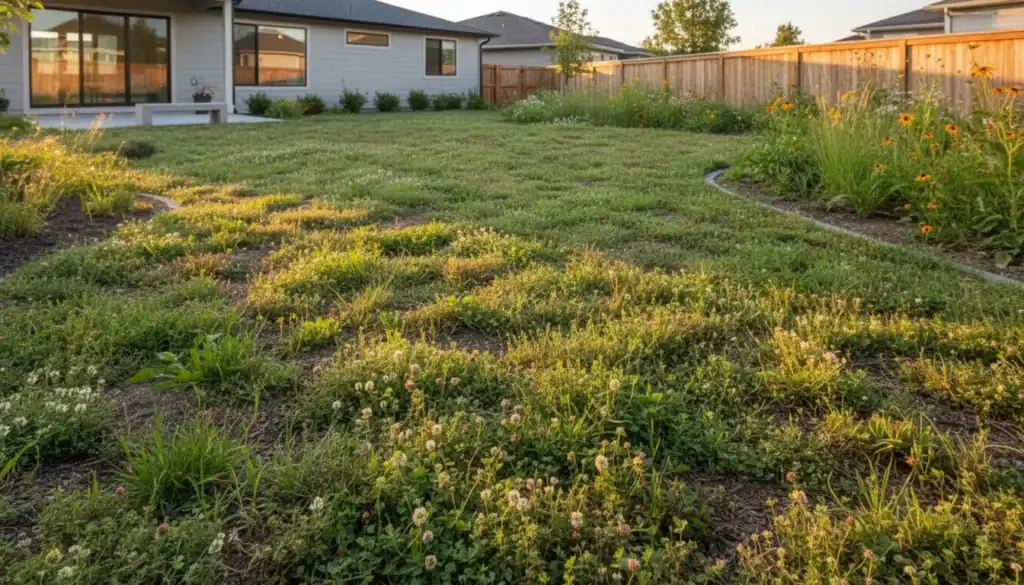
Grass alternatives offer low-maintenance, drought-tolerant options that reduce mowing, watering, and fertilizing while providing year-round coverage for your yard. Popular alternatives include white clover (requires mowing just 2-3 times per season), creeping thyme (handles foot traffic and blooms purple), and moss (thrives in shady, acidic conditions where grass struggles). Most alternatives cost 30-50% less to maintain annually than traditional turf grass.
Key Takeaways
- White clover fixes nitrogen naturally, reducing fertilizer needs by 80% while requiring only 2-3 mows per season
- Creeping thyme handles moderate foot traffic (up to 200 steps per day) and produces fragrant purple blooms from May to September
- Moss requires zero fertilizer or irrigation once established and thrives in acidic soil (pH 5.0-6.5) where grass fails
- Native groundcovers like wild strawberry cost $3-5 per square foot to establish but need no watering after year one
- Most grass alternatives reduce annual maintenance costs from $500-800 per 1,000 sq ft to $150-300
What Are the Best Low-Maintenance Grass Alternatives?
White clover tops our list for lawn replacement because it feeds itself through nitrogen fixation and tolerates drought, shade, and heavy foot traffic. This perennial legume stays green from early spring through late fall, requires mowing only when you want to prevent flowering, and costs about $2 per 1,000 square feet to seed. Honestly, clover lawns put most grass to shame when it comes to durability.
Creeping thyme ranks second for areas with light to moderate foot traffic. This Mediterranean herb releases a pleasant fragrance when stepped on, produces masses of purple flowers attractive to bees, and requires zero supplemental watering once established. Expect to pay $4-6 per square foot for plugs or $15-20 per pound for seeds.
Moss works exceptionally well in shady, moist areas where grass typically fails. Unlike grass, moss requires no soil amendments, fertilizers, or regular watering. It naturally prevents weeds and provides year-round green coverage. The University of Vermont Extension notes moss lawns can reduce yard maintenance time by 75%.

Which Grass Alternatives Handle Foot Traffic Best?
Creeping thyme withstands moderate foot traffic, about 200 steps per day according to Oregon State University research. The variety ‘Elfin’ grows only 1-2 inches tall and recovers quickly from compression. For heavier traffic areas, plant stepping stones 18-24 inches apart to distribute weight.
White clover handles heavy foot traffic better than most alternatives, including children playing and pets running. The trifoliate leaves bend rather than break, and the plant’s extensive root system prevents soil compaction. We’ve found that established clover lawns recover from soccer practice use within 48 hours, something grass rarely manages.
Chamomile works for light foot traffic areas and releases an apple-like scent when walked on. Roman chamomile (Chamaemelum nobile) stays shorter at 3-4 inches compared to German chamomile’s 12-inch height. Plant 6-8 inches apart for full coverage within one growing season.
How Do Native Groundcovers Compare to Traditional Grass?
Native groundcovers blow traditional grass out of the water. They require zero irrigation after the first year and provide habitat for local wildlife that grass cannot match. Wild strawberry (Fragaria virginiana) produces edible berries, white spring flowers, and red fall foliage while spreading through runners like grass.
Buffalo grass works in western regions with 12-25 inches annual rainfall, requiring 75% less water than Kentucky bluegrass. This native prairie grass goes dormant and turns golden-brown in winter, then greens up naturally with spring rains. Seeds cost $8-12 per pound and cover 1,000 square feet.
| Groundcover | Water Needs | Mowing Frequency | Sun Requirements | Traffic Tolerance |
|---|---|---|---|---|
| White Clover | Low | 2-3 times/season | Full sun to partial shade | High |
| Creeping Thyme | Very Low | Never | Full sun | Moderate |
| Moss | Moderate | Never | Shade to partial shade | Low |
| Wild Strawberry | Low after year 1 | Never | Partial shade to full sun | Moderate |
| Buffalo Grass | Very Low | 3-4 times/season | Full sun | High |

What’s the Best Grass Alternative for Shady Areas?
Moss thrives in shade where grass dies, particularly in areas receiving less than 4 hours of direct sunlight daily. It requires acidic soil (pH 5.0-6.5) and consistent moisture during establishment. According to the University of New Hampshire Extension, moss lawns can be established by transplanting patches from wooded areas or purchasing commercial moss slurries.
Sweet woodruff (Galium odoratum) works well under trees with its star-shaped leaves and tiny white spring flowers. This perennial groundcover spreads 12-18 inches per year and tolerates dry shade once established. Plant 8-12 inches apart in early spring or fall.
Wild ginger provides excellent coverage in deep shade with heart-shaped leaves reaching 6-8 inches tall. The native plant spreads through underground rhizomes and requires no maintenance once established. Expect full coverage within 2-3 years when planted 12 inches apart.
How Much Do Grass Alternatives Cost Compared to Traditional Lawns?
Most grass alternatives cost significantly less to maintain than traditional turf. White clover seed costs $15-25 per 1,000 square feet compared to $75-150 for premium grass seed mixtures. Annual maintenance drops from $500-800 per 1,000 square feet for traditional lawns to $150-300 for alternative groundcovers.
Initial establishment costs vary by method. Seeding alternatives costs $2-8 per 1,000 square feet, while plug installation ranges from $3-15 per square foot depending on spacing. From our experience, the higher upfront cost of plugs pays off with faster establishment and fewer weeding requirements.
Get a Free Personalised Lawn Plan
Answer 3 quick questions about your lawn and we'll build a custom care plan — tailored to your grass type, climate, and biggest challenges.
Build My Lawn Plan →Moss requires the lowest ongoing investment, zero fertilizer, minimal watering, and no mowing equipment. The main cost involves soil preparation (removing competing vegetation) and occasional pH testing to maintain acidic conditions.

When Should You Plant Grass Alternatives?
Spring planting (April-May) gives most alternatives the full growing season to establish before winter. Soil temperatures should reach 60°F consistently for successful germination. Fall planting works well in regions with mild winters, allowing root development during cool, moist conditions.
White clover germinates best when soil temperatures reach 65-70°F, typically occurring in late April to early May in most regions. Avoid planting during summer heat waves when temperatures exceed 85°F for extended periods.
Creeping thyme establishes faster from plugs planted in spring after the last frost date. Space plugs 6-12 inches apart depending on how quickly you want full coverage. In our testing, 6-inch spacing provided complete coverage within one season.
How Do You Prepare Soil for Grass Alternatives?
Remove existing grass through several methods: solarization (covering with clear plastic for 6-8 weeks), smothering with cardboard and mulch, or selective herbicide application. The University of California Extension recommends solarization as the most environmentally friendly option that kills grass and weed seeds simultaneously.
Test soil pH before planting since many alternatives have specific requirements. Moss needs acidic conditions (pH 5.0-6.5), while clover prefers neutral to slightly alkaline soil (pH 6.5-7.5). Most native groundcovers adapt to existing soil conditions without amendments. Skip the fancy soil amendments, most alternatives are tougher than you think.
Improve drainage in heavy clay soils by adding 2-3 inches of compost worked into the top 6 inches of soil. Poor drainage kills more alternative groundcovers than drought, particularly during winter months when roots sit in saturated soil.

Frequently Asked Questions
Will grass alternatives attract more bees to my yard?
Flowering alternatives like white clover and creeping thyme do attract bees, but this isn’t necessarily negative. Bees are generally docile when foraging and rarely sting unless directly threatened. You can minimize bee activity by mowing clover before it flowers or choosing non-flowering alternatives like moss.
Can I mix grass alternatives with existing turf?
Yes, many homeowners successfully overseed existing lawns with white clover to create a mixed lawn that requires less fertilizer and water. Use 2-4 pounds of clover seed per 1,000 square feet when overseeding in early spring or fall.
How long do grass alternatives take to establish full coverage?
Coverage time varies by species and planting method. White clover from seed provides 80% coverage within 60-90 days under ideal conditions. Creeping thyme plugs planted 6 inches apart achieve full coverage in one growing season, while moss can take 2-3 years to fully establish.
Do grass alternatives work in cold climates?
Many alternatives are more cold-hardy than warm-season grasses. White clover survives temperatures down to -30°F, while creeping thyme handles Zone 4 winters. Moss remains green year-round in most climates where it’s established.
Will homeowner associations allow grass alternatives?
HOA policies vary significantly regarding lawn alternatives. Check your covenant restrictions before planting, as some associations require traditional turf grass. However, many HOAs now allow eco-friendly alternatives, especially during drought conditions when water restrictions make grass maintenance difficult.