Key Takeaways
- Cordless electric mowers with 56V+ batteries handle most lawns up to 1/2 acre on a single charge
- Electric mowers cost $0.10–$0.25 per mow in electricity vs $1.50–$3.00 for gas
- No oil changes, spark plugs, or carburettor maintenance, annual upkeep is blade sharpening only
- Noise output is 65–75 dB (normal conversation level) vs 90–100 dB for gas mowers
- Main limitation: battery runtime caps cutting area at roughly 1/3 to 1/2 acre per charge
Is it worth buying an electric lawn mower?
Yes, for most homeowners with lawns under half an acre, an electric mower is worth it. You’ll save $50–$100 per year on fuel and maintenance, cut your mowing noise by 75%, and eliminate trips to the gas station. According to the U.S. Environmental Protection Agency (EPA), a single gas-powered lawn mower running for one hour produces the same amount of smog-forming emissions as driving a car 350 miles.
The value calculation is straightforward: a quality cordless electric mower costs $300–$600 upfront (comparable to a mid-range gas mower), but the ongoing costs are dramatically lower. No gasoline ($50–$75/year saved), no oil changes ($15–$25/year saved), no spark plug or air filter replacements ($10–$20/year saved), and no carburettor cleaning. The battery will last 5–8 years before needing replacement ($100–$200).
Where electric mowers fall short is on larger properties. If your lawn exceeds half an acre, you’ll either need a second battery ($150–$250) or a gas mower. Thick, tall, or wet grass also drains batteries faster, plan for 20–30% less runtime in tough conditions.
Electric vs gas lawn mower: how do they actually compare?
Electric mowers match or beat gas mowers in every category except cutting area per session and raw power on heavy overgrowth. Here’s a direct comparison across the metrics that matter most:
| Feature | Electric (Cordless) | Gas (Push) | Winner |
|---|---|---|---|
| Purchase price | $250–$650 | $200–$500 | Gas (slightly) |
| Cost per mow | $0.10–$0.25 | $1.50–$3.00 | Electric |
| Annual maintenance | $0–$15 (blade sharpening) | $50–$100 (oil, filters, plugs, gas) | Electric |
| Noise level | 65–75 dB | 90–100 dB | Electric |
| Weight | 35–65 lbs | 60–90 lbs | Electric |
| Runtime / area | 30–60 min / up to 1/2 acre | Unlimited (refuel as needed) | Gas |
| Startup | Push button | Pull cord | Electric |
| Emissions | Zero direct emissions | High (EPA concern) | Electric |
| Cutting power (thick grass) | Good (56V+) | Excellent | Gas |
| Storage | No fuel, foldable handles | Fuel stabiliser needed, larger footprint | Electric |
For the typical suburban lawn (1/8 to 1/3 acre of maintained turf), electric wins on 8 of 10 factors. Gas still makes sense for properties over half an acre, very thick grass like Bermuda or Zoysia in peak summer growth, or commercial use where continuous runtime is essential.
What are the three types of electric lawn mowers?
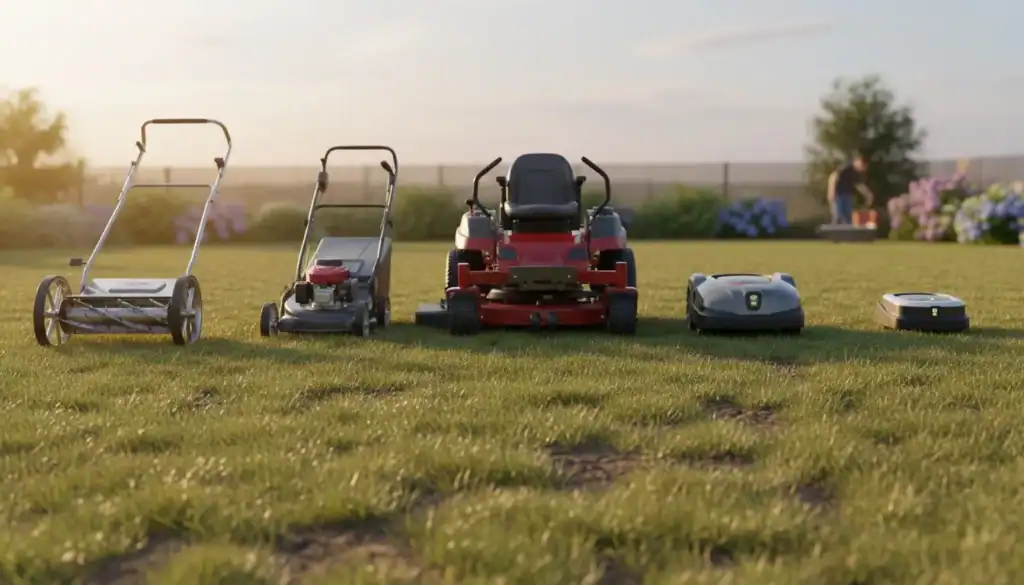
Electric mowers come in three configurations, corded, cordless (battery), and robotic, each suited to different yard sizes and budgets. Here’s how they break down:
Corded electric mowers
Corded mowers plug into a standard 120V outlet via an extension cord (typically 100 feet). They cost $150–$300, weigh 25–45 lbs, and deliver consistent power with no battery to drain. The tradeoff: you’re tethered to an outlet and must manage the cord while mowing. Best for small, flat yards under 1/4 acre close to a power source. The Oregon State University Extension Service notes that corded mowers work well for small urban lots where cord management is straightforward.
Cordless (battery) electric mowers
Cordless mowers run on rechargeable lithium-ion battery packs ranging from 20V to 80V. They combine the freedom of a gas mower with the low maintenance of electric. Most homeowner models use 40V or 56V batteries with 30–60 minutes of runtime. Premium models at 60V–80V can handle up to 3/4 acre. This is the fastest-growing category and the best all-around choice for most residential lawns.
Robot mowers
Robot mowers operate autonomously within a boundary wire (or GPS-mapped zone on newer models). They mow continuously in small increments, cutting a tiny amount daily rather than a large amount weekly. Prices range from $800 for basic models to $3,000+ for GPS-guided units. They’re ideal for homeowners who want a maintained lawn with zero effort, though they require initial setup and work best on relatively flat terrain.
| Type | Price Range | Best Yard Size | Runtime | Key Advantage | Key Limitation |
|---|---|---|---|---|---|
| Corded | $150–$300 | Under 1/4 acre | Unlimited | Cheapest, lightest, no battery to charge | Cord limits range and manoeuvrability |
| Cordless (battery) | $250–$650 | 1/4 to 1/2 acre | 30–60 min | Best balance of freedom and power | Battery runtime limits area |
| Robot | $800–$3,000+ | Up to 1 acre | Autonomous | Zero-effort lawn maintenance | High cost, setup required |
What battery voltage do you actually need?
Battery voltage directly determines cutting power and runtime. A 40V mower handles most established lawns in good condition, while 56V or higher is recommended if you have thick grass, slopes, or a yard approaching half an acre. Here’s a practical breakdown:
| Voltage | Typical Runtime | Best For | Power Equivalent |
|---|---|---|---|
| 20V | 15–25 min | Tiny yards under 1/8 acre, light trim work | Below standard gas push mower |
| 40V | 30–45 min | Standard suburban lawns up to 1/4 acre | Comparable to 140cc gas |
| 56V | 45–60 min | Larger lawns up to 1/2 acre, thicker grass | Comparable to 160–170cc gas |
| 60V–80V | 50–75 min | Lawns up to 3/4 acre, heavy grass, slopes | Comparable to 190cc gas |
Battery tip: Amp-hours (Ah) matter as much as voltage. A 56V / 5.0Ah battery stores more energy than a 56V / 2.5Ah battery, expect roughly double the runtime from double the amp-hours. If your mower comes with a 2.5Ah battery and runtime feels short, upgrading to a 5.0Ah or 7.5Ah battery is usually cheaper than buying a whole new mower.
What are the drawbacks of electric mowers?
Electric mowers have real limitations that affect certain homeowners more than others. Understanding these upfront prevents buyer’s remorse:
Battery runtime limits cutting area. Most cordless mowers run 30–60 minutes on a single charge. If your lawn takes longer than that, you’ll need to pause and swap batteries or wait for a recharge (typically 30–90 minutes depending on the charger). For lawns over half an acre, this is the biggest frustration.
Reduced power in tough conditions. Thick, wet, or overgrown grass drains batteries 20–30% faster and can bog down lower-voltage motors. If you regularly let your grass grow tall between mows, or you have aggressive warm-season varieties like Bermuda or Zoysia, a 56V+ model is the minimum.
Battery degradation over time. Lithium-ion batteries lose capacity with age and use, expect 70–80% of original runtime after 3–5 years, and replacement after 5–8 years. Replacement batteries cost $100–$250 depending on voltage and capacity.
Higher upfront cost for premium models. A top-tier cordless mower with self-propulsion and a large battery costs $500–$650, compared to $300–$400 for a comparable gas self-propelled model. The long-term savings offset this within 2–3 years, but the initial purchase stings.
Get a Free Personalised Lawn Plan
Answer 3 quick questions about your lawn and we'll build a custom care plan — tailored to your grass type, climate, and biggest challenges.
Build My Lawn Plan →Cold weather affects performance. Lithium-ion batteries lose 10–20% capacity in temperatures below 40°F (4°C). If you’re mowing cool-season grass in early spring or late autumn when it’s cold, expect shorter runtime.

How to choose the right electric mower for your yard
Match your mower to your yard size, grass type, and terrain. Use these decision points:
Yard under 1/4 acre, flat, near an outlet: A corded mower ($150–$250) delivers unlimited runtime at the lowest cost. Look for at least a 12-amp motor and a 20-inch deck.
Yard 1/4 to 1/2 acre, typical suburban: A 40V–56V cordless mower ($300–$500) with a 5.0Ah battery handles this comfortably. Self-propelled models reduce effort on gentle slopes. Choose a 20–21 inch deck for the best balance of coverage and manoeuvrability.
Yard 1/2 acre+, thick grass, or slopes: Go with a 56V–80V cordless model ($450–$650) with a self-propelled drive. Buy a second battery upfront, you’ll need it. A 21-inch steel deck handles thick grass better than a plastic deck.
Want zero effort: A robot mower ($800–$2,500) mows autonomously once set up. Newer GPS-guided models eliminate the need for boundary wire installation. Best for relatively flat yards without many obstacles.
Key features to prioritise
- Battery capacity (Ah), Higher amp-hours = longer runtime. 5.0Ah minimum for yards over 1/4 acre
- Deck size, 20–21 inches is the sweet spot. Larger decks drain batteries faster with minimal time savings
- Self-propelled vs push, Self-propelled adds $50–$100 but saves significant effort on any incline
- Mulch/bag/side discharge, 3-in-1 capability gives you flexibility for different seasons and grass conditions
- Battery ecosystem, Brands like EGO, Greenworks, and Ryobi share batteries across tools. Buying into an ecosystem saves money if you also need a trimmer, blower, or hedge trimmer
- Deck material, Steel decks withstand rocks and last longer. Polymer decks are lighter but less durable
Top electric mower brands to consider
Several brands have established strong reputations in the electric mower space, each with a different strength:
EGO, The market leader in cordless mowers for residential use. Their 56V ARC Lithium platform delivers industry-leading runtime and power. The EGO LM2135SP (21-inch, self-propelled) is widely regarded as the benchmark for battery mowers, with up to 60 minutes of runtime on the 7.5Ah battery. Price range: $400–$650.
Greenworks, Offers the widest range of voltages (24V, 40V, 60V, 80V) at competitive prices. Their 80V models compete with gas mowers on power. Best for budget-conscious buyers who still want solid performance. Price range: $250–$550.
Ryobi, The value leader with an extensive 40V battery ecosystem available at Home Depot. If you already own Ryobi 40V tools, the shared batteries make their mowers a cost-effective addition. Price range: $250–$450.
Toro, Known for build quality and durability. Their 60V Flex-Force line bridges the gap between homeowner and commercial quality. Heavier but built to last. Price range: $400–$600.
Husqvarna, Leads the robot mower market with the Automower line, offering models from small-yard units ($800) to GPS-guided commercial systems ($3,000+). Also makes quality cordless push and self-propelled mowers.
Electric mower maintenance: what’s actually required
One of the biggest advantages of electric mowers is minimal maintenance. Here’s the complete annual maintenance checklist, it takes about 15 minutes total:
- Sharpen or replace the blade, Once per season or every 20–25 hours of mowing. A sharp blade cuts cleanly; a dull blade tears grass, causing brown tips and disease susceptibility
- Clean the underside of the deck, After every 2–3 mows, scrape off accumulated grass clippings. A buildup reduces cutting efficiency and can cause corrosion
- Check the blade bolt, Ensure it’s tight before each use. Vibration can loosen it over time
- Store the battery properly, Keep it at 30–50% charge in a cool, dry location (50–80°F) during the off-season. Never store a fully charged or fully depleted battery for extended periods, both shorten lifespan
- Inspect the wheels and height adjustment, Lubricate if needed, check that height adjusters lock securely
That’s it. No oil changes, no spark plug replacements, no air filter cleaning, no fuel stabiliser, no carburettor adjustments. The University of Missouri Extension estimates that gas mower maintenance takes 2–3 hours annually, electric cuts that to 15–30 minutes. For proper mowing technique, including cutting heights, patterns, and seasonal adjustments, see our complete lawn mowing guide.
Frequently Asked Questions
Yes, for lawns under half an acre. You’ll save $50–$100 per year on fuel and maintenance, produce 75% less noise, and eliminate emissions. The upfront cost is comparable to gas ($300–$600), and long-term costs are significantly lower. The only scenario where gas is clearly better is for properties over half an acre or commercial use requiring continuous runtime.
A fully charged battery runs 30–60 minutes per session depending on voltage, capacity (Ah), and grass conditions. Over their lifespan, lithium-ion mower batteries maintain good performance for 3–5 years (500–1,000 charge cycles), then gradually decline to about 70–80% capacity. Most batteries need replacement after 5–8 years, costing $100–$250.
Yes, if you choose the right voltage. A 56V or higher mower handles thick Bermuda, Zoysia, and St. Augustine grass effectively. Lower-voltage models (20V–40V) may struggle with heavy growth. For best results with thick grass, mow more frequently so you’re never removing more than one-third of the blade height at once, and keep the blade sharp.
Significantly. Electric mowers produce 65–75 decibels, about the volume of a normal conversation or a washing machine. Gas mowers produce 90–100 decibels, which is loud enough to cause hearing damage without protection. The difference means you can mow early in the morning or in the evening without disturbing neighbours.
Most electric mowers are water-resistant enough for damp grass, but mowing soaking wet grass is not recommended for any mower type. Wet grass clumps, clogs the deck, cuts unevenly, and can cause the battery to drain 20–30% faster. If your lawn is wet, wait until the surface dries, usually 2–4 hours after rain. Never mow in active rain with any electric tool.