Fall fertilizer gives your lawn the nutrients it needs to survive winter and emerge stronger in spring. The best time to apply fall lawn fertilizer is 4-6 weeks before your first expected hard frost, typically between late August and mid-October depending on your location. Cool-season grasses need high-nitrogen fertilizer in fall, while warm-season grasses require low-nitrogen, high-potassium blends.
Key Takeaways
- Apply fall fertilizer 4-6 weeks before first hard frost (late August to mid-October)
- Cool-season grasses need 1.0-1.5 lbs nitrogen per 1,000 sq ft in fall
- Warm-season grasses should get 0.5 lbs nitrogen max, with high potassium ratios like 5-10-15
- Granular slow-release fertilizers work better than liquid for fall applications
- Water within 48 hours of application for best nutrient uptake
Why Fall Fertilization is Critical for Your Lawn
Fall fertilization prepares your lawn for winter stress and spring green-up. According to Virginia Tech Extension, fall is the optimal time to aggressively fertilize cool-season grasses because cooling temperatures and shorter days trigger root growth rather than top growth. This means nutrients go directly into building a stronger root system instead of producing excessive leaf growth that you’ll have to mow.
During fall, your grass stores carbohydrates and nutrients in its roots and crown. These stored reserves help your lawn survive winter dormancy and provide the energy burst needed for early spring growth. Skip proper fall nutrition, and your lawn enters winter weakened and struggles to recover from winter damage like snow mold, ice damage, and foot traffic.

When Should You Apply Fall Lawn Fertilizer?
The optimal timing for fall fertilizer application is 4-6 weeks before your area’s first expected hard frost. This timing allows the grass to absorb and store nutrients before going dormant. Here’s the breakdown by region:
| Region | Application Window | Target Completion Date |
|---|---|---|
| Northern States (Zones 3-5) | Late August – Early September | September 15 |
| Transition Zone (Zones 6-7) | Early – Mid September | October 1 |
| Southern States (Zones 8-10) | Mid September – Mid October | October 15 |
Apply fertilizer when daytime temperatures consistently stay below 80°F but above 50°F. Avoid fertilizing during Indian summer heat waves, this can stress your grass and promote disease.
What Type of Fall Fertilizer Should You Use?
Your fertilizer choice depends entirely on your grass type. Cool-season and warm-season grasses have opposite nutritional needs in fall.
Cool-Season Grass Fall Fertilizer
Cool-season grasses (fescue, bluegrass, ryegrass) need high-nitrogen fertilizer in fall. Look for NPK ratios between 24-4-12 and 32-0-10. The University of Illinois Extension recommends applying 1.0-1.5 pounds of actual nitrogen per 1,000 square feet during the fall feeding window.
Granular slow-release fertilizers work best for fall applications because they provide steady nutrition over 8-12 weeks. Products with sulfur-coated urea or polymer-coated nitrogen release nutrients gradually as soil temperatures drop.
Warm-Season Grass Fall Fertilizer
Warm-season grasses (Bermuda, Zoysia, St. Augustine) should receive minimal nitrogen in fall to avoid stimulating tender growth before winter. Use fertilizers with NPK ratios like 5-10-15 or 8-8-25, applying no more than 0.5 pounds of actual nitrogen per 1,000 square feet.
The emphasis should be on potassium, which helps grass cells retain water and resist cold damage. According to Texas A&M Extension, potassium applications in late summer improve winter hardiness in warm-season grasses by 20-30%.

How Much Fall Fertilizer Should You Apply?
Calculate your fertilizer needs based on your lawn’s square footage and the product’s nutrient analysis. Here’s how to determine application rates:
- Measure your lawn area (length × width for rectangular areas)
- Find the first number on your fertilizer bag (nitrogen percentage)
- Use this formula: (Target nitrogen lbs ÷ Nitrogen %) × 100 = lbs of product per 1,000 sq ft
For example, if you want to apply 1.2 lbs of nitrogen using a 24-4-12 fertilizer: (1.2 ÷ 24) × 100 = 5 lbs of product per 1,000 square feet.
| Grass Type | Nitrogen Target | 24-4-12 Rate | 32-0-10 Rate |
|---|---|---|---|
| Tall Fescue | 1.5 lbs N | 6.25 lbs | 4.7 lbs |
| Kentucky Bluegrass | 1.2 lbs N | 5.0 lbs | 3.75 lbs |
| Fine Fescue | 1.0 lbs N | 4.2 lbs | 3.1 lbs |
| Bermuda/Zoysia | 0.5 lbs N | Use 5-10-15 instead | Use 5-10-15 instead |
How to Apply Fall Lawn Fertilizer Correctly
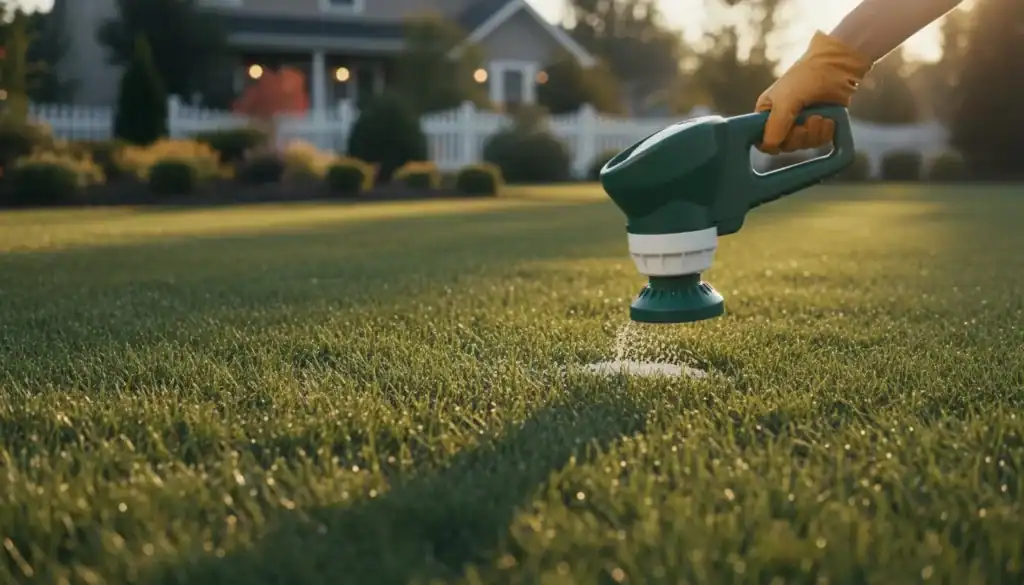
Proper application technique ensures even nutrient distribution and prevents fertilizer burn. Follow these steps for best results:
- Check soil moisture: Apply fertilizer to slightly moist soil, not wet or bone dry
- Calibrate your spreader: Use the rate chart on your fertilizer bag as a starting point
- Apply in two passes: Spread half the fertilizer in one direction, then the other half perpendicular
- Water within 48 hours: Apply 0.25-0.5 inches of water to activate the fertilizer
- Avoid overlapping: Overlapped areas receive double doses and can burn
From our experience testing different spreaders, the Scotts Elite spreader provides the most consistent coverage for granular fertilizers. Skip the cheap plastic models, uneven application wastes fertilizer and creates striped lawns.
Get a Free Personalised Lawn Plan
Answer 3 quick questions about your lawn and we'll build a custom care plan — tailored to your grass type, climate, and biggest challenges.
Build My Lawn Plan →
Should You Combine Fall Fertilizer with Other Treatments?
Fall is an ideal time to combine fertilization with other lawn care practices, but timing matters. Here’s what works well together:
Aeration and fertilizing: Core aerate first, then fertilize immediately after. The holes allow fertilizer to reach roots directly, improving uptake by 40% according to Penn State research.
Overseeding and fertilizing: Use a starter fertilizer (like 18-24-12) instead of regular fall fertilizer when overseeding. Apply at seeding time, then follow with regular fall fertilizer 4-6 weeks later.
Pre-emergent herbicides: Wait 2-3 weeks after fertilizing before applying pre-emergent herbicides for winter weeds. Some fertilizer products include pre-emergent, but standalone treatments work better.
Common Fall Fertilizer Mistakes to Avoid
These mistakes can waste money or damage your lawn:
Fertilizing too late: Applying fertilizer after your grass stops growing wastes nutrients and can encourage disease. Stick to the 4-6 week before frost rule.
Using summer fertilizer ratios: High-phosphorus summer fertilizers promote top growth you don’t want in fall. Choose fertilizers with minimal or no phosphorus for established lawns.
Over-fertilizing warm-season grass: Too much nitrogen in fall keeps warm-season grasses growing when they should be hardening off for winter. This makes them more susceptible to winter kill.
Skipping irrigation: Granular fertilizer needs water to dissolve and enter the soil. Without adequate moisture, nutrients remain on the surface and can wash away or burn grass blades.

Frequently Asked Questions
Can you fertilize your lawn too late in fall?
Absolutely. Fertilizing after your grass stops actively growing wastes nutrients and can promote disease. Apply fall fertilizer 4-6 weeks before your first hard frost when grass is still growing but slowing down. Late applications can also stimulate tender growth that won’t harden off before winter.
What happens if you don’t fertilize your lawn in fall?
Your lawn will enter winter with depleted nutrient reserves, making it more susceptible to winter damage, disease, and slow spring recovery. We’ve found that unfertilized lawns typically show more bare spots, take longer to green up in spring, and have weaker root systems. The difference becomes especially noticeable in harsh winter climates.
Should fall fertilizer have phosphorus?
Established lawns rarely need phosphorus in fall fertilizer unless a soil test shows deficiency. Most fall fertilizers use 0-4-12 or similar low-phosphorus ratios. Only use high-phosphorus fertilizers when establishing new grass from seed, as phosphorus promotes root development in new plants.
Can you apply fall fertilizer to wet grass?
Don’t apply granular fertilizer to wet grass blades, the granules will stick to leaves and can cause burning when they dissolve. Apply to dry grass with moist soil underneath for best results. If morning dew is heavy, wait until it evaporates before fertilizing.
How long does fall fertilizer take to work?
You’ll see initial green-up within 7-14 days of application, but fall fertilizer’s main benefits occur underground as roots absorb and store nutrients. Slow-release fertilizers continue feeding grass for 8-12 weeks, with the most important effects happening during the 4-6 weeks after application when roots are actively growing.