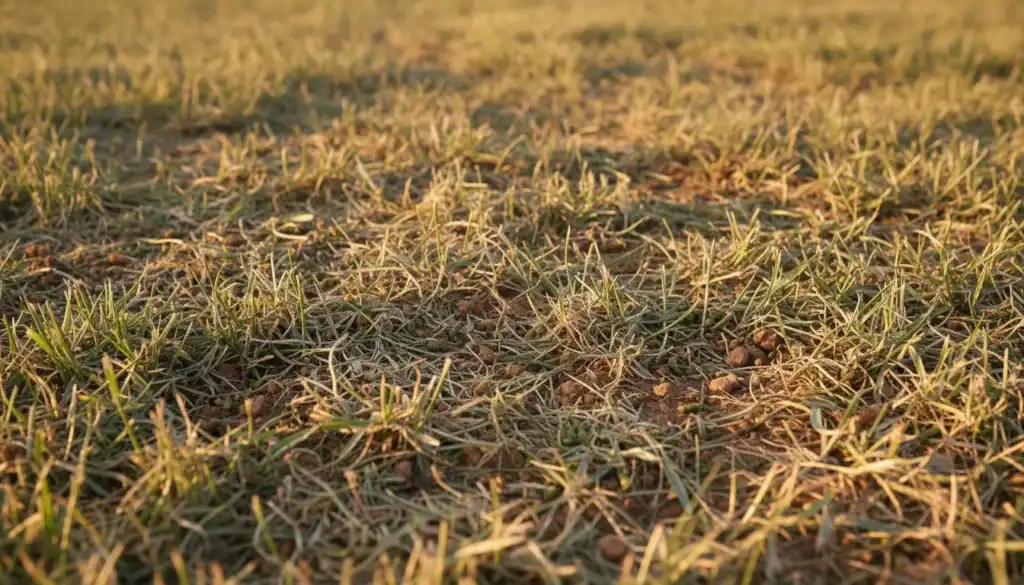
Army worms are caterpillar larvae that can absolutely destroy your lawn in just days, chewing grass blades down to the soil and leaving brown, dead patches that spread like wildfire across your yard. Fall armyworms (Spodoptera frugiperda) are the worst culprits for turfgrass, showing up from late summer through early fall when temperatures hit that sweet spot of 60-90°F. Here’s the brutal truth: you need to identify and treat these pests immediately, they can wipe out an entire lawn in 2-3 days when conditions are right.
Key Takeaways
- Army worms create irregular brown patches that expand rapidly, often overnight
- Look for small green pellets (frass) and caterpillars hiding at the base of grass plants during daylight hours
- Apply insecticide treatments in early morning or late evening when caterpillars are actively feeding
- Bermuda grass, St. Augustine, and Zoysia are most susceptible to army worm damage
- Proper lawn maintenance with adequate nitrogen reduces susceptibility to severe infestations
How to Identify Army Worm Damage in Your Lawn
Army worm damage starts as small, irregular brown spots that literally appear overnight and expand outward like they’re on steroids. Unlike brown patch or dollar spot diseases that make neat circular patterns, army worm damage is chaotic, it follows no predictable shape and can devour large chunks of lawn within 24-48 hours.
The dead giveaways include:
- Chewed grass blades: Look for ragged, uneven cuts rather than clean mower lines
- Green pellet droppings (frass): Small, dark green pellets scattered throughout damaged areas
- Rapid expansion: Brown areas that double in size daily
- Caterpillars at soil level: 1-2 inch long caterpillars hiding at grass crowns during daylight
According to the University of Florida Extension, army worms prefer stressed or over-fertilized lawns and cause the most damage when grass is actively growing in late summer and early fall.

What Do Army Worms Look Like?
Adult army worms are moths with 1.5-inch wingspans that fly at night and lay clusters of 100-200 eggs on grass blades. The destructive larvae hatch within 2-4 days and immediately start their feeding frenzy.
Army worm caterpillars have these telltale features:
- Size: 1-2 inches long when fully mature
- Color: Light green to brown with darker stripes running lengthwise
- Head: Distinctive inverted “Y” marking on the front of the head
- Behavior: Feed primarily at night and early morning, hide at soil level during hot days
From our experience, the easiest identification method is the “soapy water test”, mix 2 tablespoons of dish soap in 1 gallon of water and pour over suspected areas. Army worms will surface within 5-10 minutes if present.
Which Grass Types Are Most Susceptible?
Army worms attack virtually all grass types, but some varieties get hammered worse than others. Warm-season grasses generally suffer more extensive damage than cool-season varieties.
| Grass Type | Susceptibility Level | Damage Severity | Recovery Time |
|---|---|---|---|
| Bermuda Grass | Very High | Severe | 2-4 weeks |
| St. Augustine | High | Severe | 4-6 weeks |
| Zoysia | High | Moderate to Severe | 3-5 weeks |
| Centipede | Moderate | Moderate | 4-6 weeks |
| Tall Fescue | Low to Moderate | Light to Moderate | 2-3 weeks |
| Kentucky Bluegrass | Low | Light | 2-3 weeks |
The Texas A&M Extension notes that newly established lawns and those under drought stress get hit even harder regardless of grass type.

What Chemical Treatments Kill Army Worms?
Army worm control demands fast-acting insecticides applied when caterpillars are actively feeding. Timing is everything, treat within 24-48 hours of detection or watch your lawn disappear.
Most Effective Active Ingredients
Bifenthrin delivers the fastest knockdown, killing army worms within 2-4 hours of contact. Apply at 0.2-0.5 oz per 1,000 square feet using products like Talstar P or Bifen IT.
Carbaryl (Sevin) gives excellent residual control lasting 7-10 days. Use liquid formulations at 2-4 oz per 1,000 square feet rather than granular products for faster results.
Lambda-cyhalothrin works well for heavy infestations, providing both quick kill and 2-3 weeks of residual protection. Apply at 0.08-0.15 oz per 1,000 square feet.
Application Guidelines
- Timing: Spray in early morning (6-8 AM) or late evening (6-8 PM) when caterpillars are feeding
- Water volume: Use 2-3 gallons per 1,000 square feet for thorough coverage
- Coverage: Treat 10 feet beyond visible damage to catch advancing caterpillars
- Irrigation: Do not water for 24 hours after treatment to maximize contact time
The Clemson University Extension recommends retreating after 7-10 days if new damage appears, as eggs may continue hatching after the initial treatment.
Do Natural and Organic Controls Work?
Several biological and organic options can control army worms, though they work slower than chemical treatments and require perfect timing.
Bacillus thuringiensis (Bt) specifically targets caterpillars without harming beneficial insects. Products like Thuricide or Dipel must be applied when caterpillars are small (under 1 inch) and actively feeding. Effectiveness drops to near zero once larvae reach full size.
Beneficial nematodes (Steinernema carpocapsae) attack army worm pupae in soil but require 7-10 days to show results, too slow for active infestations. They work best as preventive treatment in areas with recurring problems.
Spinosad offers a middle ground between organic and synthetic options, providing good control within 24-48 hours while remaining relatively environmentally friendly.

How to Prevent Future Army Worm Infestations
Prevention focuses on maintaining lawn health and monitoring for early detection. Here’s the reality: army worms are migrating pests that can’t be permanently eliminated from an area.
Lawn Maintenance Strategies
Proper fertilization keeps grass healthy but not overly lush. Apply nitrogen at recommended rates for your grass type, over-fertilized lawns are like magnets for egg-laying moths. The University of Georgia Extension suggests staying within 1 pound of nitrogen per 1,000 square feet annually for warm-season grasses.
Adequate watering prevents drought stress that makes grass more susceptible to army worm damage. Maintain 1 inch of water weekly through deep, infrequent irrigation sessions.
Regular monitoring catches problems early when treatment actually works. Check your lawn weekly from August through October, paying special attention to areas that have had previous infestations.
Beneficial Insect Conservation
Natural predators significantly reduce army worm populations when present in sufficient numbers:
Get a Free Personalised Lawn Plan
Answer 3 quick questions about your lawn and we'll build a custom care plan — tailored to your grass type, climate, and biggest challenges.
Build My Lawn Plan →- Birds: Encourage insect-eating birds with water sources and habitat
- Spiders: Avoid broad-spectrum insecticides that kill beneficial spiders
- Parasitic wasps: Plant flowering plants near lawn edges to provide nectar sources
- Ground beetles: Maintain mulched bed edges where beetles can shelter
When Do Army Worms Typically Attack Lawns?
Army worm activity follows predictable seasonal patterns tied to temperature and moth migration cycles. Understanding these patterns helps with monitoring and preventive treatments.
Primary season: Late July through October in most regions, with peak activity in August and September when temperatures consistently reach 70-85°F.
Geographic progression: Adult moths migrate northward from overwintering sites in South Texas and Florida. Southern states see first activity in July, while northern regions typically don’t get hit until late August or September.
Weather triggers: Warm, humid conditions following dry spells create perfect conditions for rapid population explosions. The Auburn University Extension reports that infestations often blow up after late summer rain events break extended dry periods.
Regional Timing Variations
| Region | Peak Activity Period | First Detection | Monitoring Start Date |
|---|---|---|---|
| Florida/South Texas | July-September | June | May 15 |
| Southeast (GA, AL, SC) | August-October | July | July 1 |
| Mid-Atlantic (NC, VA, TN) | August-September | Late July | July 15 |
| Transition Zone | August-September | August | August 1 |

How to Repair Army Worm Damage
Successful lawn recovery depends on the extent of damage and your grass type’s natural recovery ability. Most warm-season grasses can bounce back from moderate army worm damage without reseeding if roots and crowns remain intact.
Immediate Post-Treatment Care
Stay off the grass for 7-10 days after treatment to prevent additional stress on damaged plants. Even light walking can break remaining grass blades and slow recovery.
Light irrigation helps surviving grass recover, but don’t overwater, that just promotes fungal diseases in stressed turf. Apply 0.5 inches of water every 3-4 days.
Hold off on fertilizing for 2-3 weeks. Damaged grass can’t use nutrients effectively, and excess nitrogen may attract new pests or promote disease.
Recovery Timelines and Methods
Light damage (less than 50% grass loss): Most warm-season grasses recover naturally within 3-4 weeks through spreading growth.
Moderate damage (50-75% grass loss): Recovery takes 4-6 weeks. Consider light overseeding with the same grass type to speed recovery.
Severe damage (over 75% grass loss): Full renovation may be necessary. Remove dead material, till lightly, and reseed or resod damaged areas.
In our testing, Bermuda grass shows the fastest recovery, often filling in completely damaged areas within 4-5 weeks during active growing season, while St. Augustine and Zoysia require 6-8 weeks for similar recovery.
How Much Damage Can Army Worms Cause?
Army worms can obliterate significant portions of a lawn with shocking speed when conditions align. Understanding damage potential helps homeowners realize why quick response matters so much.
Daily consumption rates: A single mature caterpillar devours approximately 45 square inches of grass per day. With populations reaching 50-100 caterpillars per square foot during heavy infestations, damage piles up fast.
Total lawn loss timeline: Complete lawn destruction can happen within 3-5 days during peak infestations with perfect weather conditions (temperatures 75-85°F, high humidity).
Economic impact: The University of Florida estimates that severe army worm damage can slash property values by $2,000-$5,000 due to landscape replacement costs and curb appeal loss.
Factors Affecting Damage Severity
- Population density: Light infestations (5-10 per square foot) cause spotty damage; heavy infestations (50+ per square foot) can strip lawns completely
- Grass health: Stressed lawns suffer 2-3 times more damage than healthy, well-maintained turf
- Weather conditions: Warm, humid weather accelerates feeding rates and caterpillar development
- Treatment timing: Each day of delay allows exponentially more damage as caterpillars grow larger and hungrier
The Mississippi State Extension reports that untreated infestations can consume 100% of available grass in established lawns within one week during optimal conditions.